Blasts from the past could have kick-started life
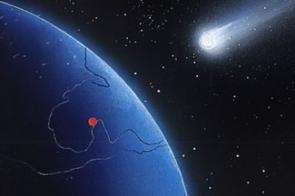
Chemical reactions in space could have triggered life on Earth, University of Leeds chemists have discovered. Evidence suggests exotic phosphorus molecules falling to Earth in meteorites may have been used in our early chemistry - giving a whole new angle on the origin of life studies - and could even lead scientists to the building blocks of life elsewhere in the universe.
Phosphorus is found in all living cells, but many scientists believe that the most common source found on Earth - phosphate - may not have been the first source used in pre-biotic chemistry. Drs Terry Kee and Dave Bryant believe the answer may lie further afield, in a more reactive type of phosphorus not found on Earth called phosphinate: “During the early stages of solar system development, our planet was bombarded with billions of tons of meteorites and cometary impacts – these impacts will certainly have brought much organic material to Earth,” said Dr Kee.
Their first challenge was to understand how these phosphinates were formed by reproducing them under ‘extraterrestrial’ conditions in a lab. They discovered creating them was much easier than expected, suggesting these ‘exotic’ molecules could actually be very common in space. Significantly, they found phosphinates in a fragment of the Nantan meteorite, which hit Earth in Guangxi, China, in 1516.
“I’m convinced the chemicals we’re seeing could be available in other places in the universe,” said Dr Kee. “If someone looking for life on other planets was to search for phosphides and water - the conditions under which other forms of phosphate can develop - it would be a very good place to start looking for other life forms.”
When these phosphinates are placed in conditions similar to those imagined on early Earth they produce organophosphorus compounds, an important step in the process towards the biological phosphates found in life on Earth. “If these phosphinates can be converted into RNA-type molecules this could provide a major link in the evolutionary chain,” Dr Kee added.
Source: University of Leeds


