Scientists find elusive waves in sun's corona
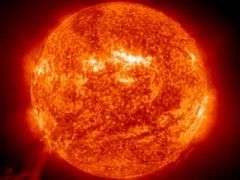
Scientists for the first time have observed elusive oscillations in the Sun's corona, known as Alfvén waves, that transport energy outward from the surface of the Sun. The discovery is expected to give researchers more insight into the fundamental behavior of solar magnetic fields, eventually leading to a fuller understanding of how the Sun affects Earth and the solar system.
The research, led by Steve Tomczyk of the National Center for Atmospheric Research (NCAR), is being published this week in Science.
"Alfvén waves can provide us with a window into processes that are fundamental to the workings of the Sun and its impacts on Earth," says Tomczyk, a scientist with NCAR's High Altitude Observatory.
Alfvén waves are fast-moving perturbations that emanate outward from the Sun along magnetic field lines, transporting energy. Although they have been detected in the heliosphere outside the Sun, they have never before been viewed within the corona, which is the outer layer of the Sun's atmosphere. Alfvén waves are difficult to detect partly because, unlike other waves, they do not lead to large-intensity fluctuations in the corona. In addition, their velocity shifts are small and not easily spotted.
"Our observations allowed us to unambiguously identify these oscillations as Alfvén waves," says coauthor Scott McIntosh of the Southwest Research Institute in Boulder. "The waves are visible all the time and they occur all over the corona, which was initially surprising to us."
Insights into the Sun
By tracking the speed and direction of the waves, researchers will be able to infer basic properties of the solar atmosphere, such as the density and direction of magnetic fields. The waves may provide answers to questions that have puzzled physicists for generations, such as why the Sun's corona is hundreds of times hotter than its surface.
The research also can help scientists better predict solar storms that spew thousands of tons of magnetized matter into space, sometimes causing geomagnetic storms on Earth that disrupt sensitive telecommunications and power systems. By learning more about solar disruptions, scientists may be able to better protect astronauts from potentially dangerous levels of radiation in space.
"If we want to go to the moon and Mars, people need to know what's going to happen on the Sun," Tomczyk says.
A powerful instrument
To observe the waves, Tomczyk and his coauthors turned to an instrument developed at NCAR over the last few years. The coronal multichannel polarimeter, or CoMP, uses a telescope at the National Solar Observatory in Sacramento Peak, New Mexico, to gather and analyze light from the corona, which is much dimmer than the Sun itself. It tracks magnetic activity around the entire edge of the Sun and collects data with unusual speed, making a measurement as frequently as every 15 seconds.
The instrument enabled the research team to simultaneously capture intensity, velocity, and polarization images of the solar corona. Those images revealed propagating oscillations that moved in trajectories aligned with magnetic fields, and traveled as fast as nearly 2,500 miles per second.
Source: National Center for Atmospheric Research


