Toolbox
- size +

Harnessing sunlight on the cheap
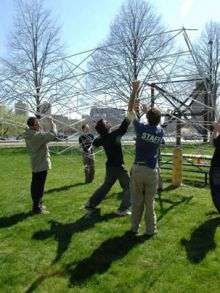
MIT students work on a new kind of solar generator that employs low-cost materials. Here they mount the frame of the concentrator (which will be mounted with mirrors) on the base near Tang Hall on Memorial Drive. Photo  Donna Coveney
MIT students work on a new kind of solar generator that employs low-cost materials. Here they mount the frame of the concentrator (which will be mounted with mirrors) on the base near Tang Hall on Memorial Drive. Photo / Donna Coveney

For a project that could be on the very cutting edge of renewable energy, this one is actually decidedly low tech--and that's the point.
A team of students, led by mechanical engineering graduate student Spencer Ahrens, has spent the last few months assembling a prototype for a concentrating solar power system they think could revolutionize the field. It's a 12-foot-square mirrored dish capable of concentrating sunlight by a factor of 1,000, built from simple, inexpensive industrial materials selected for price, durability and ease of assembly rather than for optimum performance.

Rather than aiming for a smooth parabolic surface that would bring the sunlight to a perfect focus, the dish is being made with 10-inch-wide by 12-foot-long strips of relatively low-cost, lightweight bathroom-type mirror glass. The frame is assembled from cheap aluminum tubing, with holes drilled in precise locations using a simple jig for alignment, so that the struts can be assembled into a framework that passively snaps into just the right parabolic curvature.

The control mechanism, which allows the dish to track the sun automatically across the sky, is also remarkably simple--photocells mounted on each side of the dish with opaque baffles, which cast a shadow on the cell when it drifts out of alignment, connect to a simple circuit that turns on small electric motors to push the dish back into the right position.

"The technical challenge here is to make it simple," Ahrens explains. The team is keeping careful track of all the costs for parts and the time spent on assembly, to provide a baseline for figuring out what an eventual large-scale field of such dishes would cost. "We're using all commodity materials that are all in high production," he says.

That's in stark contrast to most attempts to build solar dish concentrating systems, which have tended to use expensive custom-made equipment to achieve high efficiency. A few large companies that have built such prototypes tend to "turn it into an ultimate high-tech, high-end project," says Jefferson Tester, HP Meissner Professor of Chemical Engineering, who has been advising the student-led group. "Then Spencer came along and said, 'We're going to fundamentally change this and make this an affordable technology for popular, widespread deployment.'"

Ahrens thinks that in mass production the dishes can be competitive in cost with other energy sources and could produce heat for space heating and electric power at the same time.

The prototype isn't quite finished yet, because of delays in getting the mirror glass shipped from the factory. And the details of assembly and operation could well present some unexpected stumbling blocks, as is so often the case with new designs, Tester says. Still, "they're smart kids, they know what they're doing," he says. "That's how you learn."

This is not the kind of thing you'd build for a single-home, backyard power system, however. Because the highly concentrated sunlight will be so powerful, the team is employing several precautions to safeguard against potential safety risks, and the prototype will not operate in public without supervision.

Instead, the systems are designed to be deployed in large, utility-scale fields, fenced in to protect anyone from being in the wrong place. But because the beam comes to a focus about 12 feet from the surface, the danger is strictly localized--no risks for adjacent buildings or for planes flying overhead, Ahrens explains. When not attended, the dish will be covered "parked" pointing straight up, and will be mounted 7 feet above ground.

The students working on the project, because of their close proximity, will have to take precautions, wearing all-white clothing, to reflect the light, and welder-type goggles to protect their eyes.

Ahrens believes that such a design could quickly produce both hot water for space heating and electricity for the grid at prices that would be competitive today, unlike conventional photovoltaic systems that are still far too pricey for baseload generation. "In the sunbelt, our dish would make about 10,000 peak watts of heat and 3,500 peak watts of electricity," he says. Deployed in large numbers, the systems could make a big difference: "One square meter of concentrator is worth about one barrel of oil per year," he says.

"It's designed for long life--we hope they will last more than 30 years with good maintenance--and for indigenous manufacturing in the developing world with minimal tooling," Ahrens says. "We want to get something up that will be kind of viral and be widely adopted around the world."

Source: MIT
» Next Article in Technology - Energy: How to slash vehicle fuel use

would you recommend this story?


User Rating

4.6 out of 5 after 74 total votes
  • not at all
  • 1
  • 2
  • 3
  • 4
  • 5
  • highly

Leave a Comment or

Rank filter

Move the slider to adjust rank threshold, so that you can hide some of the comments.
Posted by 1bigschwantz 05/07/08 15:33
Rank: 5/5 after 3 votes
Interesting technology.
i wish them luck.
if the article is right, a few hundred of these things could supplly alot of juice to developing countries
Posted by Rick69 05/07/08 17:22
Not rated yet.
From my rough calculations, the wattage size they are quoting would produce roughly enough heat and electricity for one house.
Posted by weewilly 05/07/08 19:25
Rank: 3.33/5 after 3 votes
These semi-focused mirror arrays even on a small do it yourself scale can atomise an aluminum can in about 20 seconds. The biggest problem that they have with them is that they are like sails and have to be anchored securely and of course they do not work at night. Can't wait to see MIT's configuration and hopefully some specifications.
Posted by E. L. Earnhardt 05/07/08 22:15
Rank: 1/5 after 1 vote
Go to it, Kids! Cheep is the way to go!
Posted by RYM 05/08/08 01:16
Rank: 4.5/5 after 2 votes
Better and cheaper than building Nuclear
Power stations for Indonesia, Thailand,and
Indonesia. poor developing but sun rich
nations.

Hope it works & can be rolled out sooner

than later.

Posted by neptuneK 05/08/08 07:59
Rank: 5/5 after 1 vote
I think there was a competition on the very same theme at IIT-Bombay's Techfest , which took place this January.
Posted by plaasjaapie 05/08/08 10:36
Rank: 5/5 after 1 vote
This sort of nonsense has been done by students for the last 40 years. All this article demonstrates is that MIT and, indeed, the Ivy League in general has a brilliant publicity machine.
Posted by googleplex 05/08/08 10:53
Rank: 5/5 after 1 vote
What are they using as the solar energy convertor? The article only talks about the solar concentrator which is the easy part.
Posted by mrlewish 05/08/08 11:07
Rank: 5/5 after 1 vote
Seems to me they are still making it to complicated. You just need some mylar or some silvered airproof material, two rings stacked with small supports so they are separated. Wrap the stucture with the mylar kind of snuggly, suck some air out to create a parabola and viola a solar concentrator.. just add your gizmos/cells/stirling engine to the outside and put it on a pole to track the sun with a simple motor. Your done.
Posted by Mercury_01 05/08/08 11:09
Not rated yet.
I wonder if they use that hydrogen ion solar collector thing. have you seen it? it works quite well and is simple to make. I saw it on youtube, but unfortunately i dont have the link right now.
Posted by googleplex 05/09/08 18:48
Rank: 5/5 after 1 vote
Seems to me they are still making it to complicated. You just need some mylar or some silvered airproof material, two rings stacked with small supports so they are separated. Wrap the stucture with the mylar kind of snuggly, suck some air out to create a parabola and viola a solar concentrator.. just add your gizmos/cells/stirling engine to the outside and put it on a pole to track the sun with a simple motor. Your done.

How would your idea cope with wind. One big issue is that the dish acts like a sail?
What about holes like a sieve to aleviate the air pressure from wind. The other issue is what is the shelf life of mylar in the sun?
Posted by Sepp 05/10/08 10:33
Not rated yet.
All this article demonstrates is that MIT and, indeed, the Ivy League in general has a brilliant publicity machine.


Indeed.

For making hot water, there are simpler methods.

For making electricity, you need a turbine and generator. The article is strangely silent aobout that.

HOW do they propose to make electricity with their mirrors?

Posted by fireofenergy 14 hours ago
Not rated yet.
This should've been mass produced decades ago, covering the deserts. No cover needed since it uses a focal point. On such a large scale, the albedo effect has to be considered (imagine seeing "black deserts" from space covered with PV). These simply reflect the sky, and if too many were to be built (crazy robots), then we would counter the effect of melting glaciers by reflecting the sun back into space!
Easily available mass produced parts create a rugged tile like structure as the mirrors need to be tilted which allow wind to pass through.
Steam engines are not the most efficient, but giant versions (the solar tower) can generate juice on through the night!
Only post holes have to be "environmentally intrusive" and all of these things will dissapear in a few years if we do not employ solar on a vast scale soon!

Renewable energy is the cure for
Death by oil depletion