Are all males liars and cheaters? Yes -- if they're crayfish!
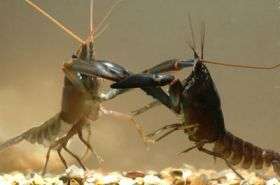
Intimidation and threats are common throughout society, whether it’s in the school playground, sporting arena or boardroom. Threatening behaviour is equally widespread among non-human animals. Individuals signal their superior strength to competitors to obtain food, resolve territorial disputes and acquire mates.
Current theory insists that signals of strength should be honest. Surprisingly researchers have found that dishonest signals are used routinely during dominance disputes by male Australian crayfish. This work will be presented by Dr Robbie Wilson (University of Queensland) on Monday 2nd April at the Society for Experimental Biology’s Annual Meeting in Glasgow.
Crayfish are a naturally aggressive species and will squabble over almost anything! Male crayfish possess enlarged front claws that they use to intimidate and fight with their competitors. An international team of researchers, led by Robbie Wilson from the University of Queensland, wanted to understand determinants of social dominance in these aggressive animals.
The scientists measured the size and strength of claws of both male and female crayfish, and then monitored how they performed in competitive bouts. They found crayfish use claw size to determine the winners of the most aggressive disputes. For female crayfish the size of the claw was an honest indication of how strong they were. However, claw size of males was not a good indicator of their strength. Males were routinely bluffing their opponents with weak claws to achieve dominance. They used claws more for intimidation than actual strength.
“Male crayfish lie and cheat their way to the top, whilst females appear to be honest displayers of their own strength”, Robbie Wilson said. “This is important work showing that dishonesty is commonly used by animals during fights”, said Wilson. “We already knew humans often use dishonesty during disputes, but our results suggest cheating may play a more important role in animal communication than previously imagined.”
Source: Society for Experimental Biology


